
For employees and colleagues at every level. Develop a shared understanding of acceptable behaviour, recognise harassment and practise safe ways to intervene. Participants explore boundaries, impact, reporting routes and how to support someone who raises a concern.
Sexual Harassment Training
Help employees recognise it. Equip managers to respond. Support leaders to prevent it.
Practical sexual harassment training for employees, managers and leaders. Build confidence to challenge inappropriate behaviour, respond to concerns and put prevention into practice, with learning tailored to your organisation in line with the Amendment of Equality Act 2010 and employment law.
All staff, managers and leaders
Virtual · In person · Hybrid
Tailored to your workplace
Choose The Right Session
Sexual harassment training for employees managers leaders
Everyone has a part to play, but their responsibilities differ. We help you select the right combination of sessions, rather than expecting one course to cover every role in the same depth.
All staff sexual harassment training
Sexual harassment training for managers
For line managers, supervisors and team leaders. Practise receiving a disclosure, checking immediate safety, recording facts and escalating appropriately. Explore confidentiality, fair treatment, protection against retaliation and the action managers should take when they witness concerning behaviour.
Leadership and organisational prevention
For senior leaders, directors and HR leads. Examine the preventative duty, organisational risks, third party exposure, policy ownership and accountability. Identify the decisions, resources and monitoring needed to turn commitments into an effective prevention plan.
Some of Our Clients & Partners










Sexual Harassment Training to support your employees:
- Recognise sexual harassment and understand professional boundaries.
- Intervene safely and know how to report concerns.
- Respond sensitively, fairly and without victimisation.
- Understand the preventative duty and what all reasonable steps means for your workplace.
Choose all staff training, a focused manager workshop or a leadership session on organisational prevention and accountability. Delivery is available virtually, in person and in hybrid environments.
Preventing sexual harassment starts with everyday action

Employees, managers and leaders need to understand what sexual harassment looks like, how to act when it happens and where to turn for support. Managers need the confidence to receive concerns properly. Leaders need to make sure policies, reporting routes and preventative measures work in practice.
Mission Diverse provides workplace sexual harassment training that connects these responsibilities.
Our sessions cover behaviour between colleagues and risks involving clients, customers, patients, suppliers and other third parties, exploring digital communication, working from home, work travel and social events.
The Preventative Duty
Sexual harassment law: what changed in 2026?
The Equality Act 2010 prohibits sexual harassment at work. The Worker Protection (Amendment of Equality Act 2010) Act 2023 introduced a proactive employer duty to take reasonable steps to prevent sexual harassment, which came into force on 26 October 2024.
From 30 October 2026, the Employment Rights Act 2025 strengthens the preventative duty to all reasonable steps. It also introduces employer liability for harassment by third parties unless the employer has taken all reasonable steps to prevent it.
Since 6 April 2026, sexual harassment has also been an expressly recognised category of wrongdoing under whistleblowing law. Protection depends on the relevant legal conditions, including a reasonable belief that the disclosure is in the public interest.
Training helps people understand these responsibilities and the action expected of them. It needs to sit alongside effective policies, risk assessment, reporting arrangements and consistent management action. A course or attendance certificate alone does not establish legal compliance.
This legal overview applies to England, Scotland and Wales. Northern Ireland has a different legal framework and requires separately adapted content.
Sexual harassment training outcomes
By the end of the relevant session, participants should be better able to:
- Identify sexual harassment and recognise conduct that breaches workplace standards.
- Explain why intention, seniority or describing behaviour as banter does not settle whether it is acceptable.
- Choose a safe response when witnessing inappropriate behaviour.
- Find and use the organisation’s reporting and support routes.
- Respond appropriately to an initial concern, within the responsibilities of their role.
- Identify practical prevention actions and understand who is accountable for them.
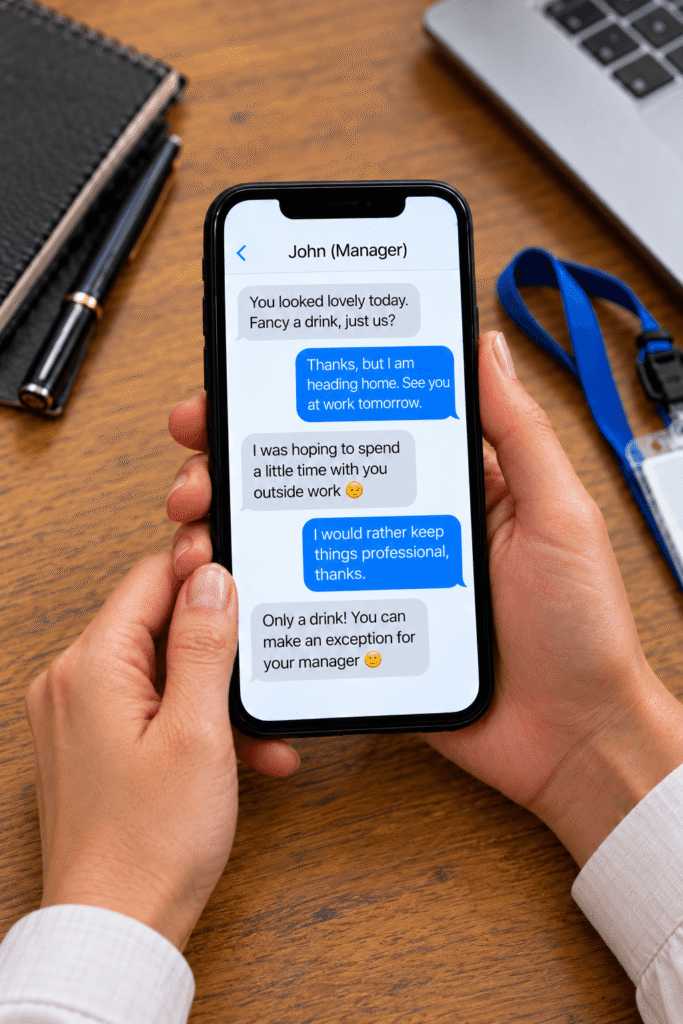
In person, virtual and hybrid sexual harassment training
We deliver live, facilitated training for organisations in England, Scotland and Wales. Sessions can be delivered in person at your venue, virtually for distributed teams or in a hybrid format where the room and technology allow everyone to participate.
Virtual sessions include facilitated discussion, polls and scenario activities. In person workshops allow more time for small group work and skills practice. For hybrid delivery, we agree how remote participants will contribute, access materials and join discussion alongside colleagues in the room.
A 90 minute staff session provides a focused introduction. Two hours allows more time for discussion and application. Manager workshops and leadership sessions can be commissioned separately or combined into a wider programme.
Our standard interactive group size is up to 20 participants, with a maximum of 25 per session. We agree accessibility requirements, adjustments and the delivery plan in advance.

Keep learning active after training
We recommend a planned cycle of induction, reinforcement, review and targeted refreshers. For many organisations, a short scenario discussion during the year and a focused six month refresher provide a useful starting point. Frequency should reflect your risks, staff understanding and evidence of what is working.
Six monthly training is our suggested approach where we refresh your employees as an effective proactive response and change in working arrangements.
Sexual harassment training Q&A's
Is sexual harassment training a legal requirement?
Employers have a legal duty to prevent sexual harassment. Appropriate training is an important part of meeting that responsibility, supported by EHRC and Acas guidance. There is no single statutory course, duration or attendance certificate that makes an organisation compliant. The training and wider preventative measures need to reflect your workplace risks.
What does all reasonable steps mean?
From 30 October 2026, employers must take all steps that are reasonable for their organisation to prevent sexual harassment. What is reasonable depends on the organisation and its circumstances. We help leaders connect training with risk assessment, clear policies, accessible reporting, third party controls and review of effectiveness.
How often should sexual harassment training be refreshed?
There is no universal six month training rule. EHRC guidance recommends regular refreshers and checking effectiveness. We can design a six month refresher cycle where appropriate, with earlier action if risks, incidents or learning gaps require it.
Do managers and leaders need different training from employees?
Yes. Staff need to recognise behaviour, intervene safely and understand reporting routes. Managers also need to receive and escalate concerns appropriately. Senior leaders need to oversee risks, resource prevention and hold the organisation accountable. We tailor the depth and activities to these responsibilities
Can you use our sexual harassment policy in the session?
Yes. We ask for your relevant policies, confirmed reporting contacts and escalation arrangements before delivery. If the preparation identifies a gap, we flag it to your nominated lead. A detailed policy review is separately scoped.
Does the training cover customers, clients and other third parties?
Yes. We use examples relevant to your organisation, which may include customers, patients, service users, suppliers and contractors. We explore prevention, safe intervention, reporting and the support staff need when behaviour comes from someone outside the workforce
Can training be delivered online or to a hybrid team?
Yes. We offer live virtual, in person and hybrid delivery. We agree the format, group size, accessibility requirements and participation arrangements with you before booking.
Can we buy the toolkit without booking training?
Yes. The standard resource package can be commissioned separately for internal organisational use. Tailoring, facilitated workshops and policy reviews are additional options. Licensing the full training materials for delivery by your own trainers is a separate arrangement.
What are the costs associated with the training?
The costs associated with training can vary depending on the program and delivery format. In-person training sessions may be more expensive due to the cost of materials and facilitator fees, while virtual and e-learning formats may be less expensive. To get a more accurate idea of cost, requests a quote from us and we’ll contact you today to provide you with the costings.
How much does sexual harassment training cost?
We provide a quote based on the audience, session length, delivery format, number of groups and level of tailoring. Optional toolkits, refresher learning and consultancy are priced separately, so you can select the support you need.